Continuation. Start here
The fate of the Bukharian Jews is closely intertwined with the
fate of other nations that lived on the Central Asian territory. This small
unique ethnical group had contributed to the development of this region in the
prerevolutionary and Soviet periods. However, Russian culture had left a strong
mark on the culture of Bukharian Jews over the last hundred years – many of
their traditions and customs have undergone the significant changes. Many
generations of intelligentsia, highly educated professionals, and skilled
workers came from Bukharian Jews.
The October revolution in 1917 and the establishment of
totalitarian regime – the dictatorship of the proletariat – became a new
landmark in the history of Bukharian Jews. The Soviet period for Bukharian
Jews, as well as for all the other people in USSR, was contradictory and
complicated period of history. In the 20-30’s there was a certain cultural
revival: the schools with instruction in native language were created, books,
newspapers, and magazines were published. A whole group of great leaders in
education, science, literature and art came from Bukharian Jews.
Nevertheless, during the years of Soviet regime establishment,
the upper-crust elite of Bukharian Jewish community was classified as
“disenfranchised” (lishentsy), and was an object to repressions until it ceased
to exist as a social stratum. A linguistic and ethnic assimilation increased
among Jews.
The continuity in the development of national culture was
disrupted with the Europeanization of Bukharian Jewry. The so-called “cultural
revolution” was carried out from the standpoint of militant atheism, with the
tendency to take people (including Bukharian Jews) away from their historical
roots and traditions. But even in this truncated form the national culture of
Bukharian Jews was not accepted by the totalitarian regime. Few years later
their cultural development was literally strangled: national schools and
theaters were closed, and publication of literature in the national language
was ceased.
During the war years of 1941-1945, 15% of Bukharian Jewish men
were drafted into the army and fought heroically against the enemy. Third part
of them never came back. At the same time many European Jews were evacuated to
Central Asia, including prominent figures in science, culture and art. They
helped to raise the cultural level of the local people, including that of
Bukharian Jews. In the “dark years” of Soviet Jewry (1948-1953), Bukharian Jews
(especially religious leaders) were subjected to brutal repressions and even
after Stalin’s death their economic and legal status hadn’t changed
significantly for the better. The religious persecution continued, and it
became increasingly difficult to maintain traditional way of living. With the
increasing campaign against the so-called “plunderers of social property” in
early 60’s, the media propagated the idea that the vast number of economic
criminals is constituted of Jews (including the Bukharian Jews). As a constant
speculation on that topic many Jews were sentenced to death or long prison terms.
And once again there was a historical paradox: in this difficult
period, skillfully overcoming the limitations associated with the policies of
the State anti-Semitism, there was a sharp growth of Bukharian Jewish
intellectual elite. A plaid of eminent scientists, artists, teachers, and
engineers came from Bukharian Jewish circles. They have made an enormous
contribution to the scientific, technical and general cultural development of
the region in health and education, as well as in the education of qualified
personnel.
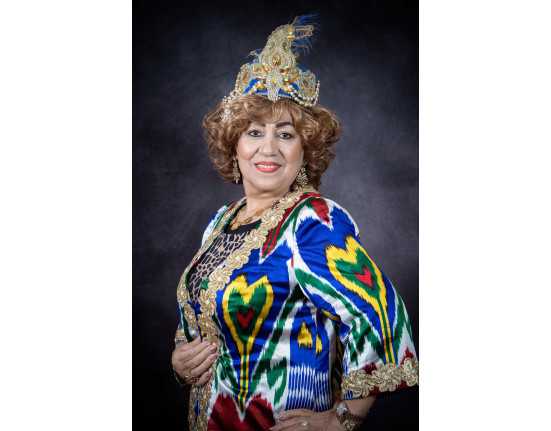
The residents of Central Asia for many centuries, Bukharian Jews
organically combined Hebrew and local traditions in their art, mainly the Tajik
and Uzbek musical culture. Musicians, singers, dancers (mostly women) were
popular not only in their own community, but also among the surrounding Muslim
population. Many of them have reached a high professional level and earned fame
and universal recognition.