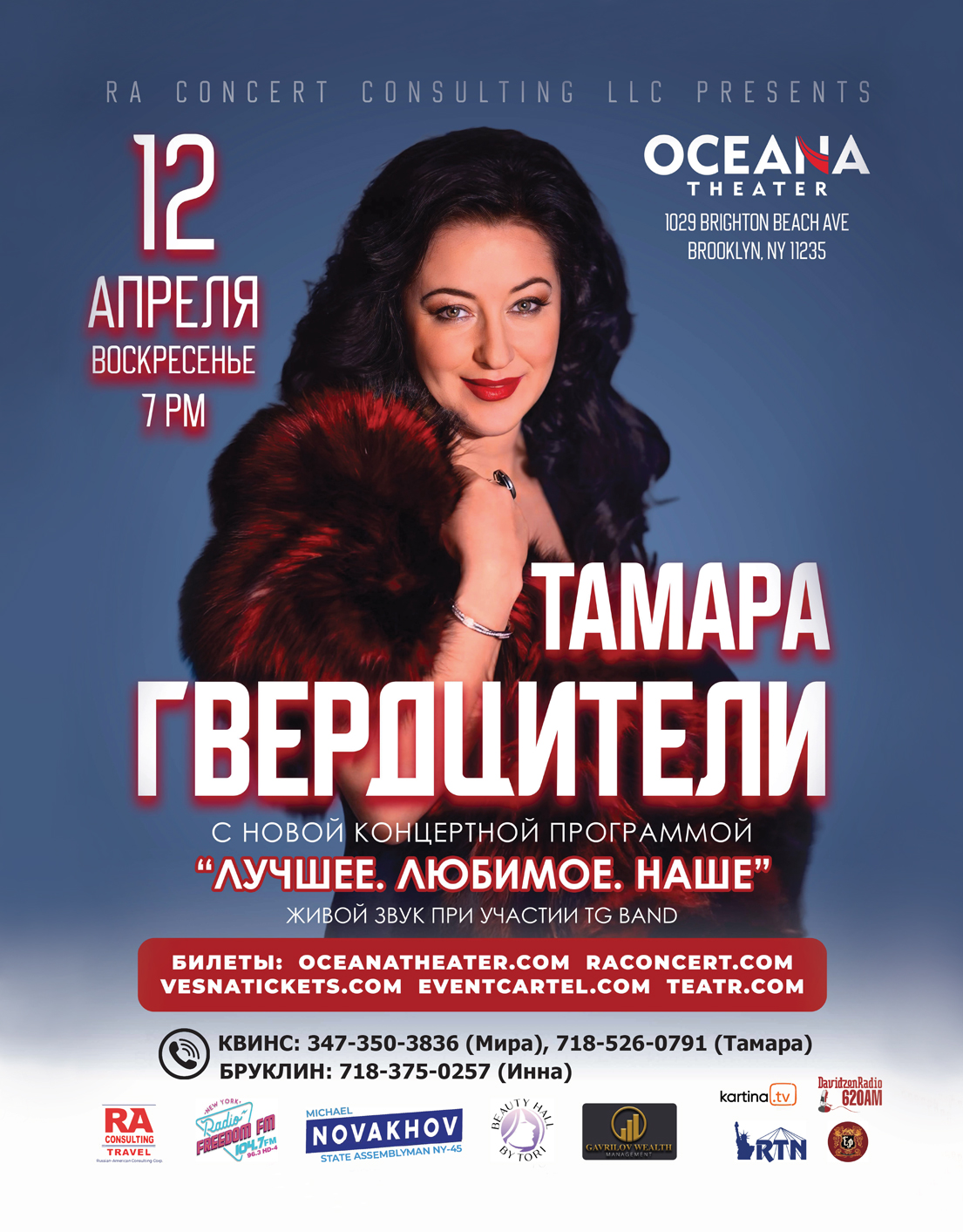
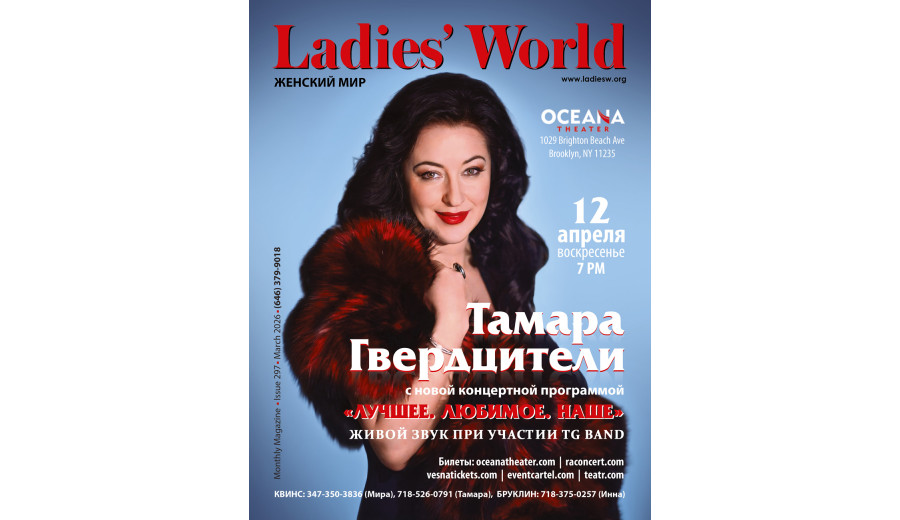
She is often described as a singer capable of turning a concert into a profound dramatic statement—even when the audience does not understand the language. She is compared to Edith Piaf for her rare ability to command a hall from the first moment to the last. This spring, Tamara Gverdtsiteli returns to the United States with her new program, “The Best. The Beloved. Ours.” Ahead of the tour, we spoke with the singer about the stage, silence, inner transformation, and what gives her the strength to remain herself in a world that is changing too quickly.
— Have geopolitical changes affected the way you structure your concert program or communicate with your audience?
— We often say, “the world has changed.” But for me, what matters more is how these changes transform us—and whether we are still capable of influencing the world through human presence, through words, through music. We truly live in difficult times, and it is impossible not to “hear” that—whether in the concert hall, backstage, or within oneself. The stage has never been merely a platform for beautiful sounds. It is a space for encounter. And every encounter reflects the circumstances we all find ourselves in—circumstances that today are deeply dramatic. That is why I feel a heightened responsibility for every nuance: for every pause, every song choice, every word I say between pieces. At the same time, I do not like straightforward slogans from the stage. Music is more subtle—but also more honest in expressing what is happening to us. If in the past one could step onto the stage as if into a celebration, today even celebration must carry meaning. It is important to me that the program not simply consist of beloved songs, but unfold as a journey—so that the audience experiences light not as decoration, but as something real, earned, and lived through.
— The pandemic and the difficult years that followed taught many of us to relate differently to silence, pauses, and solitude. Has your attitude toward the creative process and rehearsals changed?
— Silence can be healing—provided it is not the silence of emptiness. Solitude can sometimes be beneficial; it restores one’s ability to hear oneself, not to rush, to recognize what truly matters. But human beings are not meant to live in isolation. We need the eyes of another, the breath of another, the energy of presence. The pandemic years gave many of us a heavy experience: there was time, there was a “pause,” yet anxiety remained inside. And that taught us to appreciate what once seemed self-evident—the chance to rehearse together, to hear the orchestra, to argue about tempo, to search for the right tone color, to feel creative excitement. For me, rehearsals have never been mechanical repetition; they are an inner process, a tuning to the energy of the hall. Now I understand even more sharply that creativity is a living exchange. Even when you rehearse alone, you are preparing for a meeting. And that meeting is why the stage exists.
— Your performances feel deeply confessional even to those who do not understand the language. How do you achieve that?
— Confession is not a stage technique or an external style. It is not something one can learn. It comes when a person lives honestly—with everything life contains: loss, joy, doubt, gratitude. When you are young, you often think about success, about the audience’s reaction, about how you are perceived. With time comes something else—a sense of meaning. You begin to treat music as a gift and your voice as an instrument entrusted to you. And then even a beautiful lie becomes frightening. I remember listening to great artists and suddenly feeling that they were singing only for me—without display, without theatricality, simply striking the heart with precision. That is the highest mastery. If the audience cries or smiles without understanding the words, it means they heard not the text but the truth. That is why I try to sing so that every listener’s heart can hear.
— What inner changes have you noticed in yourself since your last U.S. tour?
— It is natural for a person to evolve, and I am no exception. At some point you realize that preserving yourself is also a form of movement. One cannot remain literally unchanged, because life passes through us and leaves its mark. I see that my repertoire has become more diverse—not just in languages or genres, though that matters too. I am drawn to the idea of a “color palette”: different cultures and melodic traditions can be related in their inner energy. I enjoy bringing these shades together so that they complement rather than compete with one another. There is also a personal shift: I feel boundaries more subtly now—where one must speak loudly, and where a light breath is enough; where a song should sound like a confession, and where it should sound like quiet hope or perhaps support. And perhaps most important of all, I value simple things even more—the ability to be with the audience and feel that we are not alone.
— A singer’s career is a difficult path. How do you restore your strength and energy?
— The voice is an instrument that cannot be replaced, so it must be protected. Inner balance plays an enormous role. I am deeply supported by the people I love. I am a family-oriented person, and even when we are far apart, the sense of connection provides stability. Music by great composers—Bach, Mozart—helps me immensely. It is not just aesthetic pleasure; it is a kind of purification for the ear and the soul. I also love cinema: a good film can restore inner quiet and meaning when there is too much noise around. And I always carry in my heart the words of those who have spoken about my performances with warmth and respect. In difficult creative moments, such memories are not a matter of pride but of support—as if someone reminds you that your path has meaning.
— Where does your love for singing in different languages come from, and what role will it play in the new program “The Best. The Beloved. Ours.”?
— My love for languages and cultures comes from childhood. I grew up in a family where different voices and intonations were heard naturally. I have always felt that every nation has its own beauty, its own musical memory, and it is important that this memory not disappear. For me, language is not just words—it is the melody of a nation’s breath. It is a way of feeling. When you sing in different languages, you open different windows into the same human soul. In this program, it is important to preserve that sense of luminous unity, so that each person in the hall—regardless of the language in which they think—can recognize themselves in the music. Because the true meaning of a song always passes through the heart.
— Audiences often say you sing “with your soul.” What is your main source of inspiration today?
— My audience. People who come not alone, but bring children, friends, parents. People who know how to be grateful, how to listen, how to trust. But inspiration for me is not only in being loved; it is in the ability to give. The ability to convey joy, happiness, faith in a brighter future—that is what nourishes me. Ultimately, art does not exist for vanity, but to make life easier to bear. When I see eyes in the audience begin to shine, when I sense someone straighten up, lose fear, remember something important—that is the moment of truth. It is worth stepping onto the stage for that moment alone.
— You once said, “Every concert is like a new life.” Do you still feel that way?
— Yes. Every time it is a new life. It is born at the beginning of the evening, lives through its climaxes and quiet moments, and ends when the last spectator leaves. An empty hall after a concert is always symbolic: it contains both the sadness of an ending and the anticipation of continuation. Perhaps that is the essence of the stage—to live through something together and then begin again. That is why I am so much looking forward to meeting audiences in the United States this spring. A meeting restores our faith in the ability to live through time meaningfully and fill it with light.
Interview by Denis Zakharov
New Concert Program: “The Best. The Beloved. Ours.”
April 12, 7:00 PM
Oceana Theater (New York)
Tickets: oceanatheater.com,
raconcert.com, vesnatickets.com, eventcartel.com, teatr.com
Queens: 347-350-3836 (Mira), 718-526-0791 (Tamara)
Brooklyn: 718-375-0257 (Inna)