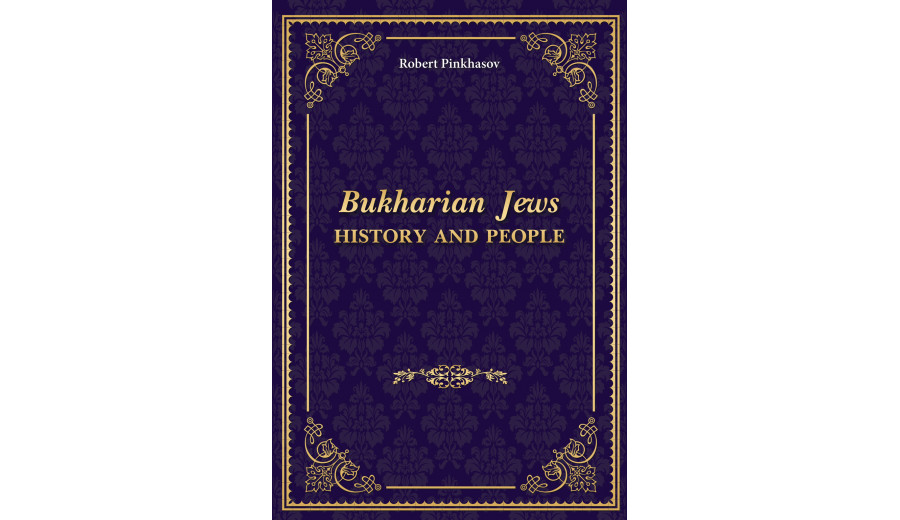
Bukharian Jews
are an ethno-linguistic group (or “eda”, which is community in Hebrew), a part
of the Jewish people that formed in Central Asia. Their native language is
Judeo-Tajik, which at times has been known as “local-Jewish”, Yahudi, Bukhori,
and sometimes considered a dialect of Tajik or Judeo-Persian languages.
Bukharian Jews are the descendants of ancient Israelites, a part of whom were
exiled after the destruction of the northern Israelite (722 BCE) and Judean
(586 BCE) kingdoms.
Most likely, Jews first appear in Central Asia during the era of the Persian Achaemenid (559-330 bce) and Arsacid Empires (248 bce -224 ce). Primary sources of the Jewish presence in Central Asia do not exist at this time. However, there are analogous letters of the Jewish community in Mtskheta in Georgia, dating back to the Achaemenids in the 4th century bce, serving as a reminder of the Jewish presence “in all of the Persian provinces”, as written in the biblical Book of Esther.
Israeli
historian M.Zand hypothesizes that Jews settled in the Central Asian provinces
of the Persian Empire during this period. Jews speaking the Parthian language
came from Jerusalem in the ranks of the exiled, the Christian work Acts of the
Apostles writes. A similar testimony can also be found in the Talmud, in the
tractate Sanhedrin 106b.
The first
primary account of Jews in Central Asia dates to the beginning of the 4th
century CE. It is recalled in the Talmud by Rabbi Shmuel bar Bisna, a member of
the Talmudic academy in Pumbeditha, who traveled to Margiana (present-day Merv,
near Bairam-Ali in Turkmenistan) fearing that wine and alcohol produced by
local Jews was not kosher. The presence of Jewish communities in Merv is also proven
by Jewish writings on ossuaries (coffins containing bones) from the 5th and 6th
centuries, uncovered between 1954 and 1956.
The spreading
of Jews throughout Central Asia is primarily the result of their participation
in the silk trade along the great Silk Road.
Islamic Period
to the 16th Century
The Arab conquest of Central Asia lasted almost a hundred years, from the mid-600s to the 740s, and it was accompanied by the implantation of Islam as the dominant religion of the conquered territories. Despite Arab literature from this period that repeatedly mentioned Jews from this region who converted to Islam, the majority of the Jewish population remained faithful to the religion of their ancestors, becoming virtually the sole confessional group in the region that preserved its pre-Islamic faith.
Muslim law
considered Jews as “People of the Book” and allowed them to hold on to their
religion under Muslim rule, under condition of paying a higher tax and
observing certain restrictive measures. Jews were required to wear distinctive
clothing; synagogues could not be built higher than mosques, etc.
As a rule,
Jews lived in separate neighborhoods, where they exercised communal autonomy.
The secular head of the community was the kalontar or elder, who was entrusted
with administrative and judicial matters, collection of taxes, and funds.
Questions of religious nature were resolved by a Rabbi.
The most
common occupations of the Jews, in addition to trade, were crafts: dyeing,
tanning business, and embossing work. The dyeing of fabric into indigo blue was
considered a specifically Jewish occupation. Jews also worked in construction,
tailoring, baking, etc.
During the
years of 1218 to 1220 there were devastating Mongol conquest by Genghis Khan,
which resulted in formation of the Chingizid dynasty. Towards the end of the
14th century, Central Asia came under the control of Timur (Tamerlane), the
founder of the Timurid dynasty.
Besides
Khorezm, Samarkand was home to a Jewish community long before the Mongol
conquest of 1220. The Jews of Bukhara, as well as Urgench, were mentioned in
the year of 1240 in the writings of Ibn-Futi.
Some
researchers have linked this influence with the formation of religious and the
political movement Hurzada in Khorezm at the end of VII, which eventually
brought to power the so-called “neo-Judaists”.
Within this
cultural-linguistic relationship, Central Asian Jews constituted a unified
whole with the Jews of Persia and Afghanistan.
To be continued