
As we work to build a better
life for our families, we must be careful not to lose the family itself along
the way.
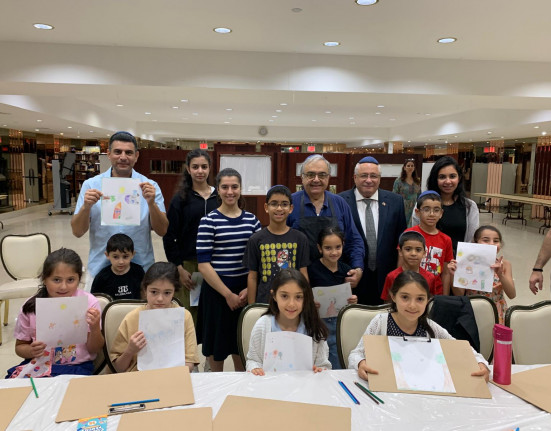
The idea for this column came to me on Yom Kippur, at the synagogue. There I met a mother with her three teenage children. I asked whether they enjoyed our Jewish holidays and why. The two older children gave almost the same answer: “Yes. Especially because during the holidays, Dad is home more.”
That simple sentence touched me deeply. It captures one
of the paradoxes of modern life: we work so hard for our families that
sometimes our families receive the least of our time, attention, and emotional
energy.
“I’m doing all of this for my family,” men often say. And
it is true. The desire to provide for those we love, build a successful career
or business, give our children a good education and a secure future – all
of this deserves respect. But where is that almost invisible line beyond which
“for the family” quietly becomes “instead of the family”?
We are always rushing. Yet a child wants to talk today – not
tomorrow. A husband or wife wants to share something now. And we answer,
“Wait.” “Not now.” “I’m busy.” “Later.”
Such a small word
– “later.” And yet, how dangerous
it can be. Children grow up. One day, the son who once waited for Dad to come
home may have grown accustomed to telling him nothing. The wife who once asked
her husband to spend the weekend together may have stopped asking. Not
necessarily because love disappeared. People simply become accustomed to living
beside one another – but no longer truly living together.
Perhaps one of our greatest mistakes is that we know how
to count money, but not time. We know what we earned last year, the value of
our home and car, the cost of a vacation, the return on our investments. But
who counts the missed family dinners? Who keeps track of the conversations that
never happened? Who counts the evenings when two people sit side by side, each
looking at a separate phone?
Sometimes we think we can express love through what we
give the people closest to us. We can buy a child the best computer, but we
cannot buy the memory of Dad teaching him to ride a bicycle. We can give a wife
expensive jewelry, but no gift can replace years of inattention. We can build
an enormous house – and still feel lonely inside it.
And yet, our happiest family memories are often
remarkably simple: sitting around the same table, talking late into the
evening, taking a family trip, Mom’s cooking, Dad’s jokes, old photographs, the
laughter of children.
The renowned Harvard Study of Adult Development confirms
what human wisdom has long understood: the quality of our close relationships
is one of the most important factors associated with a happy and healthy life.
During my many years in America, I have seen families who
arrived with practically nothing – and some who started with less than nothing.
Their success was built through years of extraordinary hard work. But sometimes
success carries a price we recognize only when it is too late.
It is no coincidence that we return to this subject more
than once in our magazine. In the article “Love on a Schedule,” published in
this issue, one point is made particularly well: work has deadlines, meetings,
and obligations – all of them claiming their place on our
calendars in advance. Family, meanwhile, is somehow expected to find a place
for itself. And too often, it is left with only the time that is no longer
there.
Olga Binyaminova also returns to this subject in her
column, reflecting on a kind of wealth that cannot be measured by money alone
(p. 32).
Of course, money matters. Providing for those we love is
itself an expression of love and responsibility. I would never suggest choosing
between family and ambition.
But love needs more than financial security. Love needs our presence.
And this applies equally to women, whose careers,
businesses, community activities, phones, messages, and endless
responsibilities can consume just as much of their lives. We can be physically
at home and still be absent from the lives of those closest to us.
Perhaps true success is not only being able to provide
for your family.
It is also making sure that,
while building a better life for them, you remain a part of that life.
Dr. Zoya Maksumova
Editor-in-Chief
(October 2026, "Ladies' World" #304)